The series begins
Where algebra comes from: Al‑Khwarizmi, al‑jabr, and why the future mathematics teachers of Pakistan are his heirs.
M. Umair Khan
Teacher educator, co‑founder of Quva, and mechanical engineer by training. Fulbright scholar, Ed.M. Harvard Graduate School of Education ’19; formerly senior lecturer with Durbeen at GECE Hussainabad. At heart, a mathematics and language enthusiast.
Teaching
Ten years of teaching, from B.Ed. lecture halls to live GRE cohorts, share one conviction: mathematics is best learned by combining reasoning with deliberate practice — understanding first, then fluency. These videos show what that looks like in practice — a series I created for future teachers, moments from real classrooms, and test‑prep instruction at Quva.
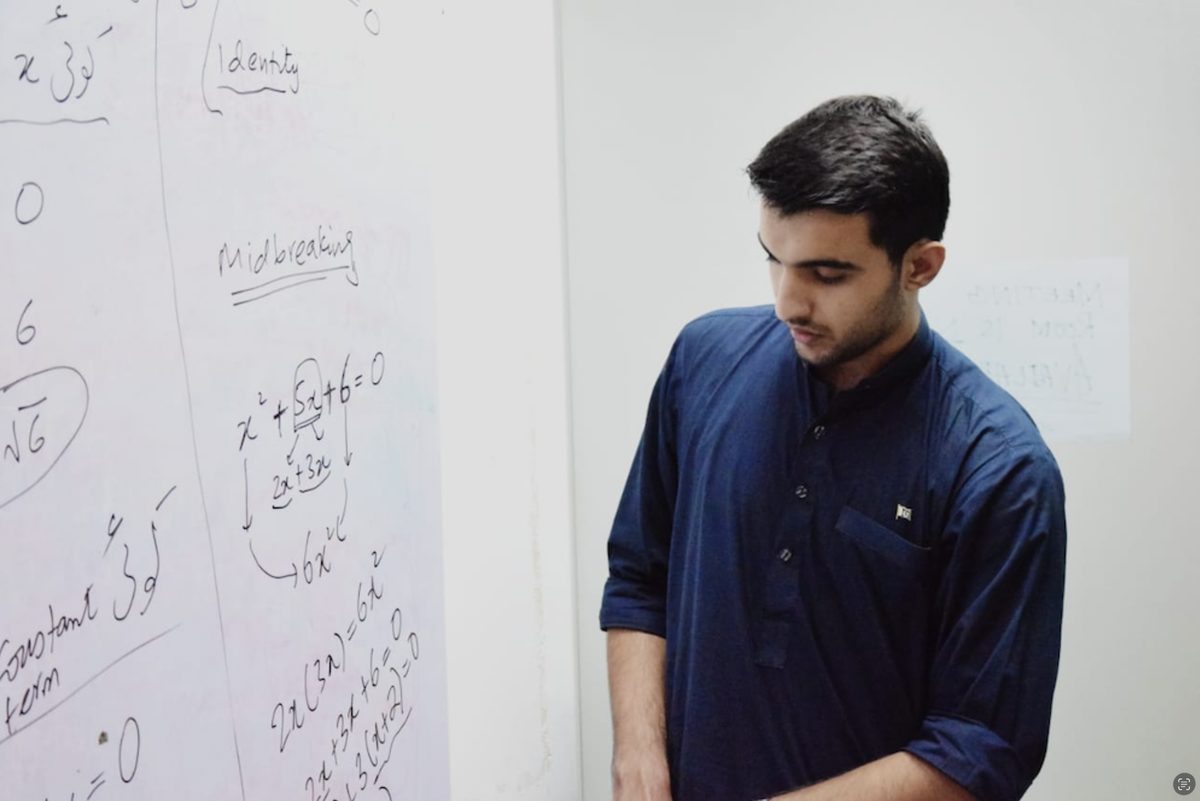
A video series I conceived, scripted, and presented for Durbeen’s GECE Hussainabad — tracing algebra from Al‑Khwarizmi’s Al‑Jabr wal‑Muqabalah to the modern classroom, with my student‑teachers taking the lead as the series unfolds.
Where algebra comes from: Al‑Khwarizmi, al‑jabr, and why the future mathematics teachers of Pakistan are his heirs.
A student‑teacher unpacks a classic teaching error — treating variables as objects rather than numbers — and why it fails learners.
Two final‑year student‑teachers research balance models and digital tools for teaching equality — the series’ arc paying off.
Theory at work in real classrooms: a ready‑made teaching tip, and an assessment that helped my student‑teachers see the value of games in mathematics education.
Making negative‑integer arithmetic concrete with two‑colour counters — the way I model pedagogy for pre‑service teachers.
For their General Mathematics assessment, my student‑teachers analysed Pakistan’s most‑played games as engines for developing mathematical concepts.
The same reasoning‑first approach, applied to the GRE — from a live online cohort and from the studio.
A model lecture from a live Quva GRE cohort: a counting problem worked end to end on a digital whiteboard, reasoning first.
A studio walkthrough of the GRE’s most misunderstood question type — and the habits of mind that make it routine.
Now building
An educational services company I co-founded: premium test preparation, teacher training, and consultancy — built in Pakistan, bilingual by design.
Practice sessions, timed full-length tests, question and vocabulary banks, progress analytics — and Quva Rehbar, a bilingual English–Urdu AI tutor.
gre.quva.appProfessional development for schools and school systems, with testimonials and video proof from delivered programs.
ed.quva.appStructured IELTS preparation from the same team.
ielts.quva.appWhat Quva is, who we serve, and how to work with us.
quvapro.comResearch & Writing
Published work, a manuscript under review, and a data study from earlier in the journey — plus one essay that explains why language runs through all of it.
A quantitative study of reading outcomes for 1,100+ primary students across 12 schools, analysing the Happy Readers literacy intervention. Harvard Graduate School of Education, 2019.
Translation: for W. M. Sipra’s bilingual Urdu–Punjabi volume Gawaacha Lahore (2020), I translated a chapter of Fouzia Saeed’s Taboo! The Hidden Culture of a Red Light Area (Oxford University Press).
Selected talks: Durbeen Research Expo 2025 · SPELT International Conference 2024 · SZABIST University keynote 2024 · AKU-IED International Conference on Technology, Pedagogy and Society 2023 · IATEFL Teachers Research Conference 2023 · Inaugural HGSE Ed Talks, Harvard Graduate School of Education 2019.
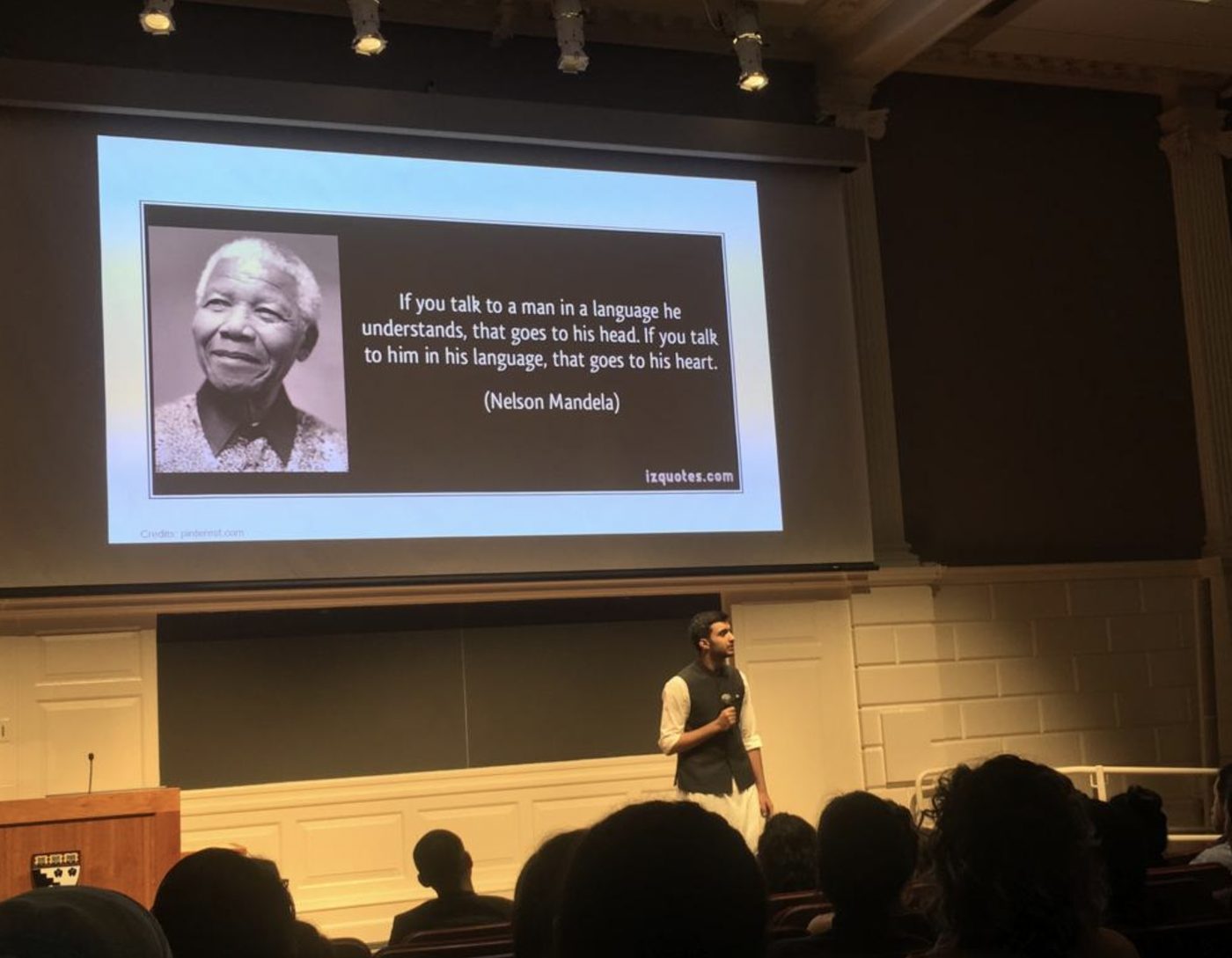
Delivered at the inaugural HGSE Ed Talks · Harvard Graduate School of Education · April 2019
I come from Pakistan. More than 70 languages are spoken in Pakistan. The majority of them I cannot even name. I myself grew up speaking Urdu, which is the only constitutionally recognized national language and a lingua franca across the country. Before independence, Pakistan was part of the British Empire in India; and like everywhere else that the British ruled, they left us with the parting gift of the English language.
My talk tonight is about my personal journey through the complex world of linguistic identity and diversity, and how HGSE shaped my views about language and education. My story begins with my very first encounter with Punjabi, the language of the most populous province in Pakistan. In the heart of the Punjab province where I lived when I was eight, it was implicitly understood in my privileged setting and even explicitly reminded sometimes, that Punjabi was a language that only the uneducated and the unrefined spoke. At school, speaking Urdu made me culturally and linguistically superior to my Punjabi-speaking class fellows, who were deemed too rustic, or “Paindu”, as they would derisively be referred to. Remember this word, “Paindu”, it will come up again.
This power and prestige differential wasn’t of course just limited to Punjabi and Urdu. All sorts of stereotypes were perpetuated by speakers of one language about speakers of another. For instance, some thought that Pashto, which is another major language, was a harsh and jarring tongue. One of the jokes that they used to make, one that embarrasses me to my core as I recollect it tonight, went like this, “If you take a handful of pebbles, put them all in a jar, and then shake the jar, the sound that results is the sound of Pashto.” To this day, I hate myself for having once laughed at such derogatory jokes.
It is very likely that many of the speakers of these regional languages would have viewed my privilege with a lot of resentment, especially when language and accent can be a huge barrier to social mobility. And yet, at another level, another exchange between resentment and snobbery was happening, one in which the role of resenter was switched. I, with my preference for Urdu, used to view the English-speaking elite of my country with the same indignation as a Paindu would view me with; in return, I feared being judged with the same snobbish and elitist mindset that I viewed the Paindu with. My relative lack of proficiency in speaking English, even though I went to an English-medium school, always made me insecure in front of the rich kids in the town, who grew up soaked in the Anglicized culture of the powerful elite.
Fast forward to eight months ago, when I came to live, for the first time ever in my life, in an English-speaking country. By now, I was already a changed man in many respects. I had already begun, some four or five years ago, the critical internal work of correcting my biases and cultivating an appreciation for linguistic diversity in myself. I had also by now grown a lot in terms of the “cultural capital” associated with knowing English. In all these years, I had made a good number of friends from the Anglophile elite, had received all of my sixteen years of education in English, had even watched a sizeable number of English films and had a playlist of English songs on my phone (though I could never get the lyrics just by listening). And yet, my first experience of living here in the United States, and having to communicate, for the major portions of my days, in a language that was still foreign to me, left me defeated most of the time. There was so much that I knew but could not clearly articulate, so much I felt but could not truly express. I couldn’t even get the jokes that my classmates cracked. I felt so dumb. The first few weeks were emotionally exhausting; I was homesick most of the time, always craved to converse in Urdu with any person who remotely knew it, and when at the end of each day I finally got to talk to my roommate in Urdu, it was always such a relief. It was during this unsettling experience that I started appreciating a quote from Nelson Mandela that I had read a long time ago, and which is also the inspiration for the title of this talk. The quote went like this: “If you talk to a man in a language he understands, that goes to his head. If you talk to him in his language, that goes to his heart.” Oh boy, I felt so happy when someone spoke to me in my language. Forget speaking, even when someone just expressed a desire to know more about my language, I felt that my identity was being valued. I could finally know what being a linguistic minority feels like, and how hard it is when you’re thrown into a linguistic environment that you’re not used to. Well, actually, no, I still could not truly know. I still could not truly know because I wasn’t made fun of or looked down upon because of my lack of command over English, or my imperfect or inconsistent accent; I didn’t face the derision that a Paindu has to go through.
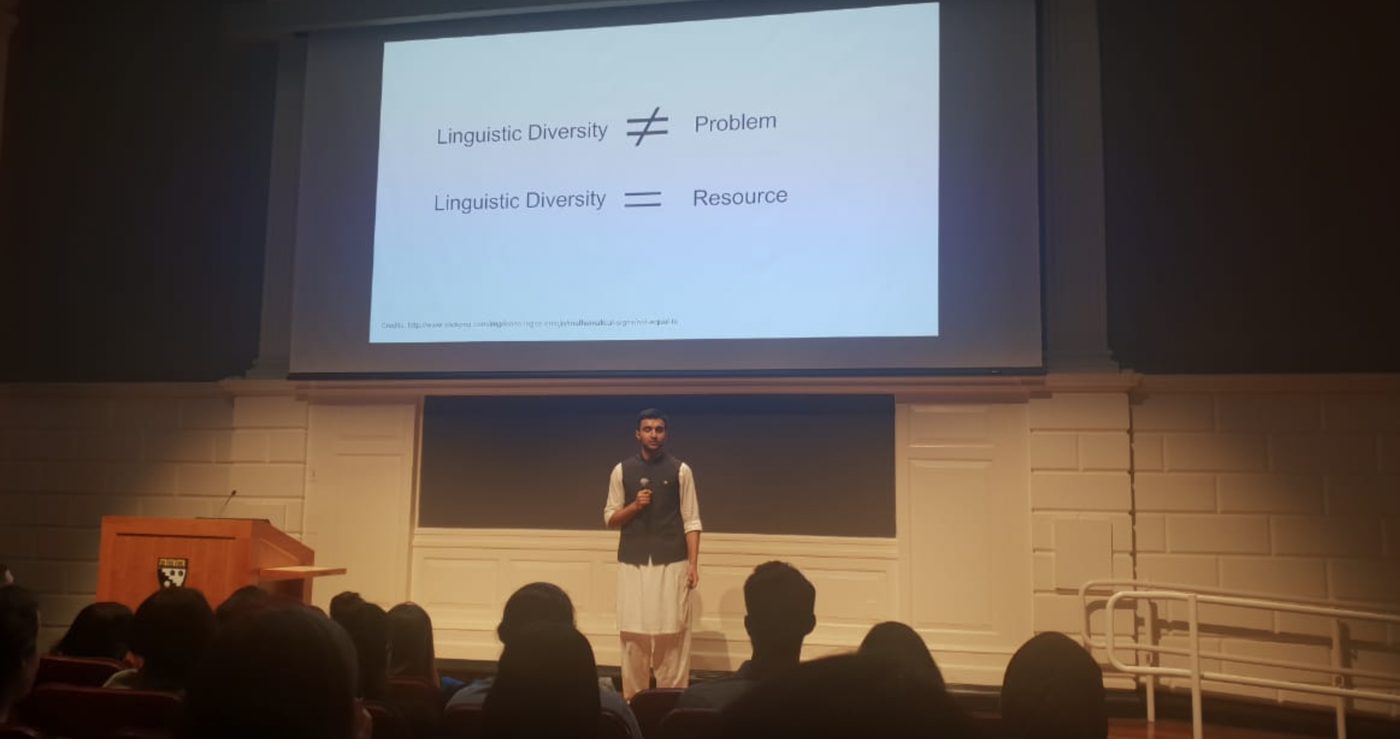
Anyhow, the months progressed, I became more and more comfortable, in fact, I started loving my time here; but the experience of those early weeks at HGSE has stayed with me. I have spent most of my time here either thinking about language, taking courses related to language, learning a new language, or simply marveling at scenes of people laughing and chatting in Spanish or Korean or Arabic or Mandarin. Over the past eight months, I have become fascinated with the subject of language, especially the important educational dimension of it. Some of the courses that I have taken here at HGSE have grounded me in the attitude that linguistic diversity in educational settings is a resource and not a problem. And I continue to wonder what took me so long to realize this. Surely it was privilege: privilege blinds us to the most obvious, the most basic of realities. I had to go through the discomfort myself to be able to empathize better. In this respect, and in many other respects too, my experience here at HGSE has been a lesson in humility.
During the last semester, a couple of my Indian friends here at HGSE have been kind enough to teach me how to read and write in their beautiful language Hindi, a process that I have thoroughly enjoyed. This experience of learning a new language encouraged me to go for more, so I enrolled in a Farsi language course this semester; again, I am absolutely loving it! I don’t know what the future holds, but I have a strong feeling that my time here at HGSE has put me on a path of exploring the beautiful world of languages. This summer, I am going to Istanbul for an Arabic language program. And I hope that after returning to Pakistan, I can finally begin to learn at least some of the many beautiful languages of my people. Or if I cannot do that, I hope that, at the very least, I can play my part in helping kids learn and express in the language that speaks to their heart and to help them see the beauty and value in other languages and other perspectives, something that took me so long to learn.
Media & Speaking
Teacher-education reform, argued on national television and beyond.
Representing Durbeen on national television: reforming teacher education, and the case for first-language instruction in the early years.
A long-form conversation on structural reform — why Pakistan’s education system needs stronger institutions, and how teacher training changes what children learn.
On Durbeen’s model of teacher education — how courses are designed, how quality is kept high, and how future teachers are transformed — in a film produced with Getz Pharma.
For Global Schools Forum: presented Durbeen’s teacher-development model in depth at a GSF Community of Practice webinar (December 2024), alongside a Durbeen colleague — watch from my segment.
Earlier conversations: a two-part podcast on education in Pakistan (2020) — Part 1 · Part 2.
Consultancy
Curriculum, assessment, and teacher development — for organisations across Pakistan and beyond.
Developed a Grade 5 mathematics Scheme of Studies mapped to the 2024 Sindh curriculum, and ran teacher focus groups to evaluate and refine the Grades 1–4 scheme adopted in Zindagi Trust government schools.
2026Consulted for the Department of Education on mathematics courses for a master’s programme preparing public-sector teacher educators.
2024–25Designed pedagogical-content-knowledge (PCK) assessments for middle- and secondary-school mathematics teachers.
2024Designed and led teacher- and mentor-training workshops across Gilgit-Baltistan and Islamabad Capital Territory, reaching several hundred participants.
2024–25About
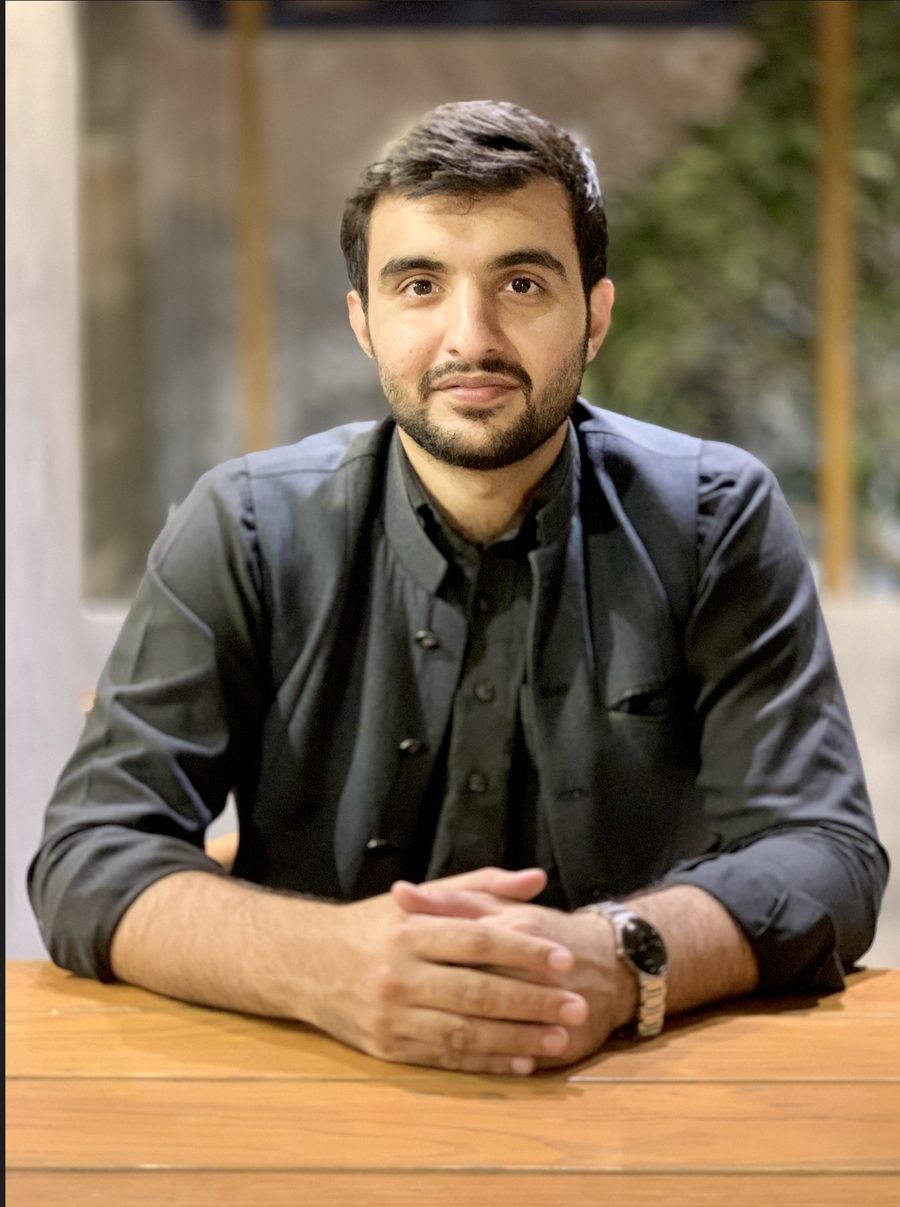
I’ve worked across Pakistan’s education sector since 2016 — as a teacher educator, researcher, consultant, and education entrepreneur. A mechanical engineer by training (NUST), I completed my Ed.M. at the Harvard Graduate School of Education in 2019 as a Fulbright scholar, where my final course research project examined the relationship between language of instruction and mathematics outcomes in Punjab.
For nearly five years I served with Durbeen as senior lecturer in mathematics at the Government Elementary College of Education, Hussainabad — designing and teaching the full continuum of B.Ed. mathematics pedagogy courses to around 200 student-teachers across four cohorts, and mentoring graduates through their first years of teaching in Zindagi Trust government schools as their school–college liaison.
Today I run Quva full-time as co-founder and lead instructor. Over the past decade I’ve coached 3,000+ test-takers — including 70+ online GRE cohorts since 2020 and one-to-one tutoring across every section of the test — built the Quva GRE web app and its bilingual English–Urdu AI tutor, and expanded into IELTS preparation and teacher training. Alongside, I consult on curriculum, assessment, and teacher development.
Two convictions hold all of it together: that mathematics should be taught reasoning-first, with fluency built on understanding rather than on rote; and that children learn best in the language that speaks to their heart.
Contact
Consultancy, teacher-training partnerships, speaking, and research collaboration — recent engagements include curriculum design, teacher assessment, and mentor-training workshops for organisations across Pakistan and beyond.
umairkhan@alumni.harvard.edu